Website link: Health Data Standards and Terminologies: A Tutorial
What it is
Health Data Standards and Terminologies: A Tutorial” is a free, self-paced online course from the U.S. National Library of Medicine. It is organized into modules with a navigation menu, interactive pop-ups, and a knowledge check at the end of each module. I reviewed Module 1, mainly the Interoperability page and the Module 1 Knowledge Check.
How it teaches interoperability
The tutorial teaches interoperability as a layered idea. It introduces the HIMSS definition, then breaks the concept into four levels: foundational (one system can receive data from another), structural (the format of the data), semantic (preserving meaning and context), and organizational (governance, policy, and trust). It then applies the levels to a real example, the Health Hero app for youth leaving foster care, by revisiting a project from an earlier video. This moves the learner from “systems exchange data” toward “systems and organizations share meaning,” the shift in thinking that makes interoperability a threshold concept.
Critique using Mayer’s principles
Segmenting and signaling. The course is divided into short pages within four modules, and a menu shows where the learner is. Prev and Next buttons and interactive pop-ups let learners reveal information at their own pace, which supports Mayer’s segmenting principle. Numbering the four levels also signals the structure of the concept.
Screenshot 1: Course Menu (Interoperability Page)
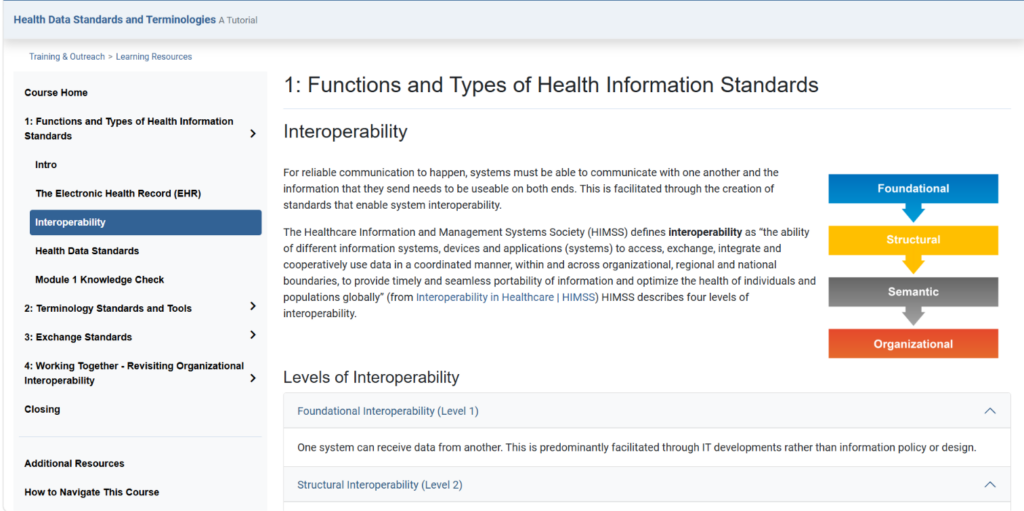
Pre-training. Module 1 moves from the electronic health record to interoperability to standards, so key terms are defined before they are needed. The four levels are explained before the Health Hero example uses them.
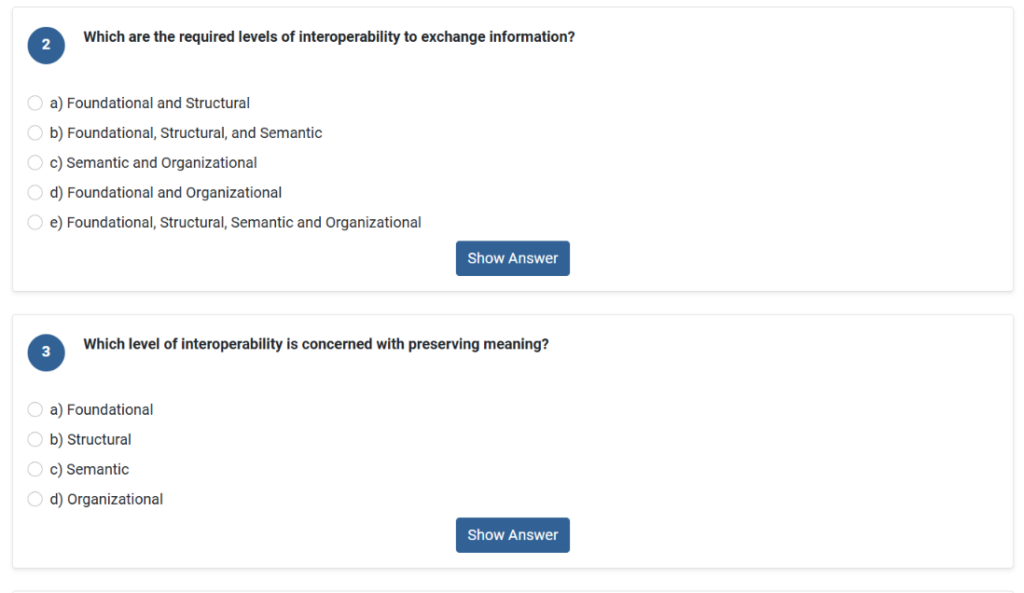
Active learning and self-explanation. The Knowledge Check has five questions, such as which level preserves meaning, and learners can retake it as many times as they like. Because learners choose answers from a list, this is the “active” level in Chi’s framework, similar to menu-based self-explanation prompts. It supports retrieval practice, but it does not ask learners to explain an answer in their own words, so it stops short of the constructive level.
Screenshot 2: Example of Active Learning (Knowledge Check)
Coherence and load. The pages are mostly text with graphics. The HIMSS definition is one long sentence, which is dense for a beginner and adds intrinsic load. A short plain-language summary beside it would help.
My Experience
I like this format because it lets me focus on the parts where my knowledge is weak. The pop-ups let me click to learn more and absorb information at my own pace, and the quiz lets me test myself, which makes the material stick. I would pair it with note-taking and work through it section by section, in order. The downside is that it takes time, and some people may prefer a video, but the effort it demands forces me to retain more. Unlike the podcast in review 2, it provided me with visual cues and a way to check my knowledge, full proofing my ability to retain it.
Verdict
A strong choice for learners willing to put in effort. I would add a short worked example and ask learners to explain answers in their own words.